nwDaq-R3 subrack platform
The nwDaq-R3 is the third revision of a subrack platform designed to house remote data acquisition and logging devices in the form of plug-in units. It is compliant with the IEC 60297-3 standard and utilizes common components that are widely available from multiple manufacturers and distributors.
1. Introduction
The nwDaq-R3 platform is based on a standard IEC 60297-3 subrack. For detailed information on the subrack assembly and its components, including dimensions, please refer to the Mechanical design section. This section covers topics such as side panels, horizontal rails, rail positions, subrack sizes and depths, backplane mounting, front panels and blinds for plug-in units, plug-in units themselves, and backplane connector layouts.
The Electrical design section provides details on the signals on the backplane, including power rail types, power classes, and redundant communication buses for both low-power, slow and high-speed data transfer.
To ensure software compatibility, the Communication protocols section outlines the protocols used on the
nwdaq-nbus2 bus, as well as the 10Base-T1S and 100Base-T1/1GBase-T1 buses. Additionally, this section describes
the protocol used for the nwdaq-pbus bus, which is employed for communicating power resource information.
2. Mechanical design
2.1. Horizontal rail position and side panel dimensions
The platform uses only 3U high subracks. Height of the subrack assembly is 132.35 mm.
Width of the subrack is variable. The following rules must be respected:
one horizontal pitch unit
HPis5.08 mmwideunit width is exactly
4 HP, yielding20.32 mm. We call it a module.the first
HPstarts2.54 mm(0.5 HP) from the leftthere is an additional
0.5 HPat the end of the rail
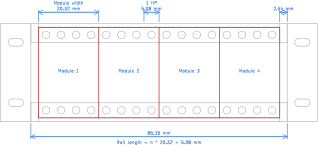
Fig. 2.1 Front horizontal rails with rack-mountable side panels (drawing not to scale)
The resulting horizontal rail length is (n * 20.32 + 5.08) mm, n being the count of modules
in the subrack assembly. Table below lists some common combinations and rail lengths.
Modules |
Width in HP |
Rail length in mm |
Comment |
|---|---|---|---|
10 |
41 |
208.28 |
Size for 10” racks |
21 |
85 |
431.80 |
Size for 19” racks |
Side view of the subrack with the corresponding dimensions is pictured below.
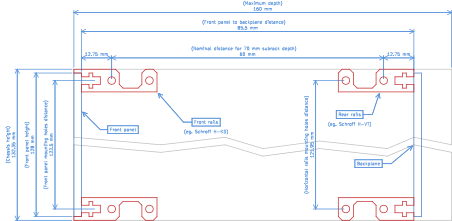
Fig. 2.2 Side panel with horizontal rails attached, side view
2.2. Plug-in unit front panels
The cceptable thickness of the front panel is 2, 2.5 and 3 mm. Width of the front panel is calculated as
n * 20.32 - 0.30 mm, where n represents the width of the unit in modules with each module being 20.32 mm
wide. For a 1-module wide plug-in unit, the nominal width is 20.02 mm. The height of a 3U front panel is
128.4 mm.
Front panels contain two holes for attaching to a PCB, they are horizontally centered to the second HP from the left.
Vertical distance of the holes is 99.00 mm, diameter is 2.7 mm and they are vertically centered.
Near the bottom PCB holder hole, there are multiple helper holes to aid in the alignment of the front bracket/holder.
These holes are spaced 5.08 mm apart, typically one hole to the left and two holes to the right of the PCB holder
hole. Please refer to the figure below for further clarification.
Front panels are secured to the subrack front rails using two M2.5 screws for 1 module wide units and four
M2.5 for units that are 2 modules or wider. The attachment holes are horizontally centered in the second HP from
the left (and second HP from the right for 2-module and wider units). The holes are vertically centered and their
vertical distance is 122.5 mm.
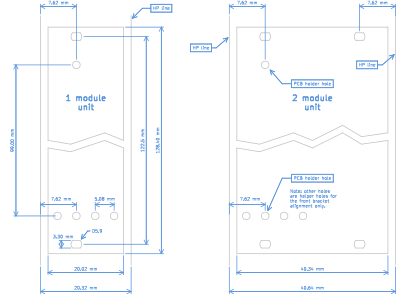
Fig. 2.3 Front panel for 1 module wide plug-in unit
2.3. Plug-in unit PCB dimensions
A single plug-in unit comprises of at least these components:
front panel with the specified design
front panel bracket/holder to assist with pullting the unit out of the subrack
two PCB holders
one or more backplane connectors on the back
PCB
For more elaborate designs there may be more components in a single unit, eg. multiple PCB holders when more than one PCB is used, helper connectors, PCB cover, etc.
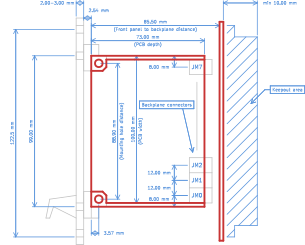
Fig. 2.4 Dimensions of a plug-in unit main PCB
3. Electrical design
3.1. Overall concept
Plug-in units are interconnected with a backplane mounted on the rear horizontal rails within the subrack. Power to the backplane is provided using bidirectional/source units from their respective front panels. Data communication and any field connections are only done on plug-in unit front panels.
3.2. Backplane connections
The backplane provides redundant low power rails, a high power rail, redundant nqdaq-nbus communication
buses, nwdaq-pbus power resource communication bus, 10Base-T1S multidrop ethernet bus and 100Base-T1/1GBase-T1
point-to-point links. WIth the exception of the last one, all interconnections are using the bus topology.
Point-to-point ethernet links use star topology, more on that in the corresponding section. There are no external
connections going to the backplane except connections allowing backplane stacking.
As a result, nwdaq-r3 platform backplane can be fully passive. There are no mandatory components on the backplane
except:
nwdaq-nbus2bus termination (both ends)10Base-T1S bus termination (both ends)
nwdaq-pbuspull-up resistor
All connections are organized into 8 backplane connectors with designations JM0 to JM7. The following table lists all connections within the particular backplane connector.
Connector |
Name |
Description |
|---|---|---|
JM0 |
Basic power and data |
Contains the required minimum for a unit. It carries |
JM1 |
Redundant power and data |
This is a redundancy and data speed extension. It carries
an independent |
JM2 |
App specific, star |
Application-specific fanout of 10 differential lanes, connections to other units are dictated by the backplane design. See JM2 addendums for commonly used connections. |
JM3 |
Reserved |
|
JM3 |
Reserved |
|
JM3 |
Reserved |
|
JM3 |
Reserved |
|
JM3 |
High power bus |
Carries signals and buses for high power units. |
The following subsections briefly describe all available power and data buses.
3.2.1. nwdaq-nbus2 data bus
nwdaq-nbus is designed with the following constraints and requirements in mind:
very low power during the idle state with commonly available CAN bus transceivers
moderate speeds achievable (1-4 mbit/s on the backplane, 250 kbit/s nominally over long runs)
initiator driven MAC (token passing) or CSMA/CA/CD MAC
wired-OR operation to avoid power peaks during collisions
source-based communication using topics to mimic MQTT (publish/subscribe) or request/response communication to follow the RPC concept
packet-switched
native encryption using pre-shared keys providing basic security on the MAC level
packet size up to 1024 B (this limit is TBD)
On the physical layer (L1) level, the bus uses CAN signalling as specified in ISO 11898-2.
Common CAN transceivers can be used to access the nwdaq-nbus2 bus. CAN MAC is not used.
Detailed description of the nwdaq-nbus2 protocol on the MAC and higher levels can be found in the
corresponding section nwdaq-nbus2.
Note
There is also a legacy possibility of tunneling nqdaq-nbus over a CAN 2.0b bus. This concept is not part
of this specification as it is no longer recommended nor used.
3.2.2. VBUS_LP and VBUS_LP2 low power bus
VBUS_LP buses carry 5 V power to plug-in units, 4 A maximum per unit. The total aggregated backplane
current is limited to 8 A. The bus uses its voltage to communicate the current available amount of power
in total. It is called power-availability, where pa-- state means the shortage is
long lasting, all backup resources are deprived and power failure is imminent, pa- is the common state when eg.
running on batteries, pa0 means the energy sinking/sourcing is in balance, pa+ means there is a surplus of
energy available (eg. to charge backup batteries) but the amount of energy is limited, pa++ means there is a
power source with virtually infinite capacity (an AC connection for example).
pa0 is always at the nominal bus voltage level, 5 V for VBUS_LP. pa- and pa-- are 5% and 10% less
tha nominal, respectively. pa+ and pa++ are 5% and 10% more than nominal. There is a +-2.5% tolerance on the
voltage levels, that is, pa- being -7.5% to -2.5% lower than the nominal voltage, for example.
Voltage levels lower than 7.5% less than the nominal voltage are considered bus undervoltage and must trigger
plug-in units UVLO protection disconnecting the units from the bus.
Voltage levels higher than nominal + 7.5% are considered overvoltage and all units must deal with it individually by
cutting the bus off (an OVP protection).
Additionally, all sinking units must limit their current sink to the value specified in the corresponding unit
datasheet, no more than 4 A, which is the maximum current possible for the VBUS_LP bus. This limit protects
the backplane connector and wiring and maintains availability of the bus power in case of a misbehaving unit. The
same applies to sourcing units which are required to source power in a CC/CV manner, limiting the current to 4 A
per VBUS_LP. This protects the unit itself from possible bus shorts.

Fig. 3.1 Graphical representation of power availability levels for VBUS_LP and VBUS_HP
Note
For practical reasons, VBUS_LP voltage levels are compatible with USB 2.0 and USB 3.0 voltages and it can
be interfaced with them using minimum amount of components. The power availability feature together
with the sinking/sourcing regulation on individual units help sink the power without overloading the USB port.
3.2.3. High power bus VBUS_HP
VBUS_HP bus provide the same functionality as VBUS_LP, with higher voltage levels. The nominal VBUS_HP
voltage is 26.4 V, power availability levels remain the same. The bus voltage is usually referred to as 28 V
despite not being strictly true. Maximum current per unit is 4 A for standard units, yielding 105 W of
available power. When appropriate measures are taken on the unit, the maximum current per unit can be 10 A
(264 W of power).
The total current permissible to be carried over the backplane is 40 A and is limited by the
backplane design and thermal management. Refer to the backplane datasheet for the exact figure.
Note
Again, for practical reasons, voltage levels on VBUS_HP are compatible with 12-cell lead-acid batteries
and with 8-cell LiFePO4 battery packs. Under specific circumstances and using appropriate protections,
such battery packs can be connected to the VBUS_HP bus directly without any further regulation.
3.2.4. Ethernet data connection over 10Base-T1S
3.2.5. Ethernet data connection over 100Base-T1/1GBase-T1
3.2.6. Application specific differential lanes
3.3. Backplane connector pinouts
Backplane contains slots for 8 connectors named JM0 to JM7. Not all of them need to be used. These are the usual combinations:
JM0 only - for simple units, no requirement for redundancy
JM1 only - not possible
JM0+JM1 - redundant low power bus and redundant communication bus
JM0+JM1 - simple units with fast data transfer requirement (100Base-T1/1GBase-T1)
+JM2 - ethernet switching boards, USB hub boards, etc.
JM7 only - high power units, photovoltaic input units, battery packs
JM0+JM7 - power supplies, external power bus interfaces
3.3.1. JM0
JM0 connector provides power and data for simple and low power units usually in the 1-3 power class. No power or communication redundancy is available if only JM0 is used. Signal placement on the connector is optimized to allow using PCBs made with simple processes, 2 or 4 layer.
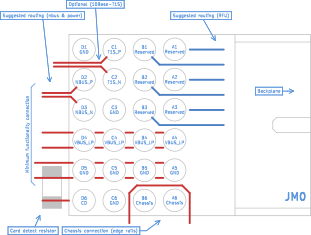
Fig. 3.2 Backplane connector pinout and suggested routing - JM0
Signal |
Description |
|---|---|
CD |
Card detect. Connect resistor to GND or VBUS_LP.
See |
CH |
Chassis ground. See |
GND |
Plug-in unit main ground connection. |
VBUS_LP |
Lopw-power bus connection |
T1SP |
10Base-T1S bus, positive |
T1SN |
10Base-T1S bus, negative |
NBUSP |
|
NBUSN |
|
3.3.2. JM1
JM1 connector provides redundant VBUS_LP power and nwdaq-nbus data communication. For units with
higher data transfer requirements, 100Base-T1/1GBase-T1 interface is available.
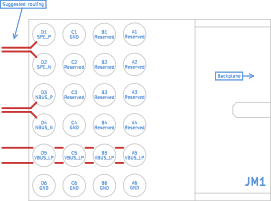
Fig. 3.3 Backplane connector pinout and suggested routing - JM1
Signal |
Description |
|---|---|
3.3.3. JM2
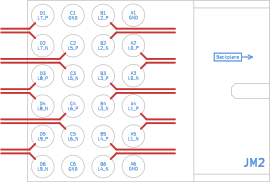
Fig. 3.4 Backplane connector pinout and suggested routing - JM2
Signal |
Description |
|---|---|
3.3.4. JM7
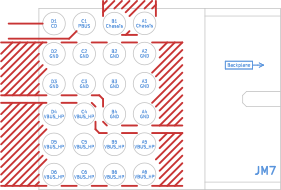
Fig. 3.5 Backplane connector pinout and suggested routing - JM7
Signal |
Description |
|---|---|
3.4. Unit power sinking/sourcing considerations
Note
Describe requirements for power filtering, maximum power levels, hot-plug/unplug management, etc.